FAQ
Frequently Asked Questions About Steel Grating
Find answers to common questions about steel grating types, materials, ordering, and more from GratingPro's expert team.
Browse Questions ↓
FAQ
Materials
What materials are available?
We manufacture steel grating in three primary material categories: carbon steel, stainless steel, and galvanized steel. Carbon steel (Q235, SS400, or A36) is our standard material, offering excellent strength at a cost-effective price point, suitable for most indoor industrial applications. Stainless steel 304 provides superior corrosion resistance for food processing, pharmaceutical, and general chemical environments, while stainless steel 316 offers enhanced resistance against chlorides and harsh chemicals, making it the preferred choice for marine and offshore applications. Hot-dip galvanized steel grating starts as carbon steel and receives a protective zinc coating through immersion in molten zinc at approximately 450°C, delivering long-term corrosion protection for outdoor and high-humidity installations at a moderate cost premium over bare carbon steel.
How long does hot-dip galvanizing last?
Hot-dip galvanizing provides long-term corrosion protection for steel grating, with typical service life ranging from 20 to 50 years in most industrial environments, depending on exposure conditions. In moderate atmospheres such as rural or light industrial settings, galvanized coatings can last 50 years or more before requiring maintenance. In harsh marine or chemically aggressive environments, the coating life may range from 15 to 25 years. The zinc coating thickness for standard steel grating typically ranges from 85 to 200 microns per ASTM A123 specifications. The protective mechanism works through both barrier protection and galvanic (sacrificial) action, where zinc corrodes preferentially to steel, protecting exposed edges and scratches. Regular visual inspection and touch-up of damaged areas can extend the service life indefinitely.
Ordering & Pricing
What is the minimum order quantity (MOQ)?
Our standard minimum order quantity for stock size steel grating panels is 50 square meters for carbon steel and galvanized grating. For stainless steel grating, the MOQ is typically 30 square meters due to higher material costs. Small orders below MOQ can be accommodated on a case-by-case basis with a small order surcharge to cover setup and cutting costs. For custom specifications involving non-standard bar sizes, special materials, or unique fabrication requirements, the MOQ is generally 100 square meters. We also offer a sample program (see below) for customers who wish to evaluate product quality before placing a bulk order. MOQ requirements may be waived for first-time customers placing trial orders, subject to sales team approval.
What are your payment terms?
Our standard payment terms are 30 percent deposit by T/T (telegraphic transfer) with the 70 percent balance paid before shipment upon inspection approval. For established customers with a proven transaction history, we can offer more flexible terms including 30 percent deposit, 70 percent against copy of shipping documents. For large orders exceeding 50,000 USD, we also accept irrevocable letters of credit (L/C) at sight from major international banks. L/C terms require full documentation including commercial invoice, packing list, bill of lading, and certificate of origin. We do not offer open account terms for first-time buyers. All payments must be received in full before cargo release unless alternative arrangements have been approved in writing by our finance department.
What is the typical lead time?
Our typical lead time for standard steel grating products is 15 to 25 working days from deposit confirmation, depending on order quantity and current production schedule. For small orders of stock sizes under 100 square meters, lead time is generally 10 to 15 working days. For large orders exceeding 500 square meters or custom specifications requiring special tooling or material procurement, lead time ranges from 25 to 40 working days. Hot-dip galvanizing adds approximately 5 to 7 working days to the lead time. We maintain inventory of common sizes in carbon steel and can offer expedited production for urgent orders at a 10 to 15 percent surcharge. We recommend contacting our sales team with your specific requirements to obtain an accurate lead time estimate.
Do you offer custom sizes?
Yes, we offer full customization of steel grating panels to match your project specifications. Custom options include non-standard panel dimensions, special bearing bar spacing, unique bar heights and thicknesses, custom cutouts for pipe penetrations or structural columns, angled cuts, notching, banding, and bend-down or serrated edges for stair treads. We can manufacture grating in virtually any size up to 1800 mm wide by 9000 mm long, limited only by material availability and transportation constraints. To request custom grating, please provide a detailed drawing or specification sheet including required dimensions, load requirements, material grade, surface treatment, and any special fabrication needs. Our engineering team will review your requirements and provide a technical proposal within 48 hours.
How do I get a quote?
Getting a quote from GratingPro is simple and typically takes less than 24 hours. You can submit your inquiry through our contact page, send an email to sales@dtsteelladder.com, or contact us directly via phone or WhatsApp. To receive an accurate quotation, please include the following information: type of grating required (welded, press locked, serrated, etc.), material specification, bearing bar dimensions (height and thickness), bar spacing, panel sizes and quantities, surface treatment (plain, painted, or hot-dip galvanized), and any special fabrication requirements. Our sales team will review your specifications and provide a detailed quotation including FOB price, packaging details, estimated lead time, and shipping options. For large or complex projects, we offer free technical consultation to help you select the most cost-effective grating solution.
Do you offer samples?
Yes, we provide product samples to qualified buyers for quality evaluation before placing bulk orders. Sample sizes are typically 200 mm x 300 mm panels and are available for all grating types and materials. Sample pricing is as follows: carbon steel and galvanized samples are complimentary with the buyer covering shipping costs (approximately 30 to 60 USD via international courier). Stainless steel 304 and 316 samples are available at a nominal charge of 20 to 40 USD per sample plus shipping. Sample requests are typically processed within 3 working days. The sample cost is deductible from your first bulk order of 100 square meters or more. Please contact our sales team with your specific sample requirements including type, material, and surface finish.
What is the FOB price range for different types?
FOB prices vary depending on material, type, dimensions, quantity, and surface treatment. As a general reference, standard carbon steel welded grating typically ranges from 30 to 60 USD per square meter FOB Tianjin/Qingdao. Galvanized steel grating ranges from 45 to 85 USD per square meter. Press locked grating in carbon steel is approximately 35 to 70 USD per square meter. Serrated steel grating is priced similarly to welded grating with a small premium of approximately 5 to 10 percent for the serration process. Stainless steel 304 grating ranges from 90 to 160 USD per square meter, while stainless steel 316 grating ranges from 130 to 220 USD per square meter. Heavy duty grating with thicker bearing bars is priced 15 to 30 percent above standard welded grating prices. Please note these are indicative ranges only; exact pricing depends on your specific requirements and order volume. Contact our sales team for a firm quotation.
Products & Applications
What is steel grating and what are its main uses?
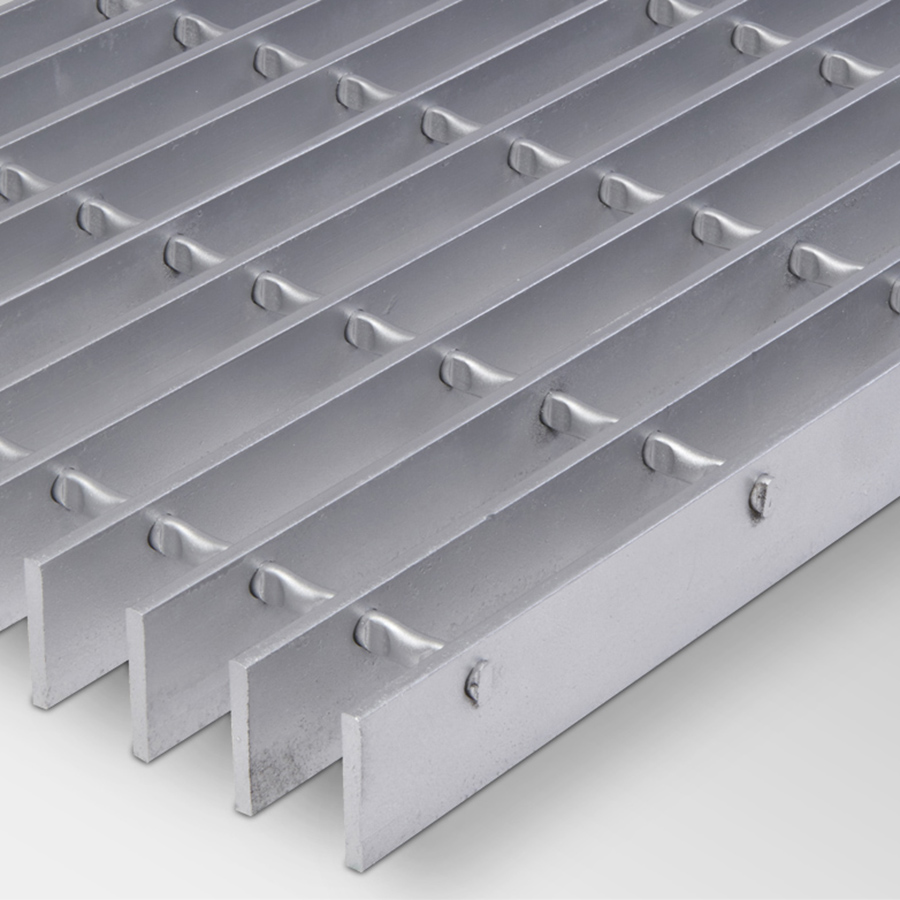
Steel grating is a fabricated metal grid structure made from load-bearing bars with consistent spacing, designed to support heavy loads while allowing light, air, water, and debris to pass through. It is typically manufactured by welding or pressing flat steel bars together into a durable grid pattern. Steel grating is widely used in industrial flooring, walkways, platforms, trench covers, stair treads, mezzanine floors, drainage covers, and safety barriers across industries such as oil and gas, chemical processing, power generation, water treatment, mining, food processing, and construction. Its combination of strength, durability, and open-area design makes it a versatile solution for heavy-duty applications where safety and drainage are essential.
What types of steel grating do you offer?
We offer five main types of steel grating: welded steel grating, press locked grating, heavy duty steel grating, serrated steel grating, and stainless steel grating. Welded steel grating is our most popular type, made by fusing bearing bars and cross bars at every intersection under high heat and pressure for maximum strength. Press locked grating uses mechanical locking without welding, providing a smooth surface ideal for architectural and light-to-medium industrial applications. Heavy duty steel grating features thicker bearing bars for extreme load requirements in mining and heavy manufacturing. Serrated steel grating has V-shaped notches on the bearing bar surface to enhance slip resistance in wet or oily environments. Stainless steel grating is manufactured in 304 or 316 grades for corrosion resistance in food processing, marine, and chemical plants.
Quality & Certifications
What certifications do you have?
GratingPro is ISO 9001:2015 certified for quality management systems, ensuring consistent product quality and continuous improvement across our manufacturing processes. Our steel grating products comply with multiple international standards including ASTM A36 (carbon steel), ASTM A240 (stainless steel), EN ISO 14122 (safety of machinery permanent means of access), and DIN 24537 (steel grating standards). We provide mill test certificates and material traceability documentation with every shipment upon request. Our hot-dip galvanizing is performed by certified partners who comply with ASTM A123 and ISO 1461 standards. For specific project requirements, we can arrange third-party inspection by SGS, Bureau Veritas, or other internationally recognized inspection agencies at the buyer cost.
Specifications
What are the standard sizes and specifications?
Our standard steel grating specifications include bearing bar heights from 20 mm to 75 mm (1 to 3 inches) and bearing bar thicknesses from 3 mm to 8 mm (1/8 to 5/16 inches). Common bar spacings are 30 mm, 40 mm, and 50 mm on center, with cross bar spacing typically at 50 mm or 100 mm intervals. Standard panel sizes range from 1000 mm x 6000 mm (3.3 ft x 20 ft) and can be cut to exact dimensions upon request. We manufacture to international standards including ASTM A36, ASTM A1011, EN ISO 14122, and DIN 24537, depending on the target market and application requirements. Custom dimensions, bar profiles, and load capacities can be engineered to meet specific project needs.
Types Comparison
What is the difference between welded and press locked grating?
Welded steel grating is manufactured by placing bearing bars and cross bars into a fixture and then applying high electrical current and pressure to fuse them at every intersection, creating a permanent metallurgical bond. This process results in the strongest possible grating structure, making welded grating ideal for heavy industrial applications, high-traffic areas, and load-bearing floors. Press locked grating, on the other hand, uses a mechanical cold-pressing process where cross bars are punched through and locked into bearing bars under tons of pressure without any welding or heat. The advantage of press locked grating is its smooth, flat surface with no weld marks, making it aesthetically suitable for architectural applications, platforms, and light-to-medium duty walkways where appearance matters. However, welded grating offers approximately 20 percent higher load capacity than equivalent press locked grating.
What is the difference between serrated and plain surface grating?
Plain surface grating has smooth, flat bearing bar tops that provide a standard walking surface suitable for dry, clean environments such as indoor platforms, mezzanines, and general industrial flooring. Serrated surface grating features V-shaped notches or teeth cut at regular intervals along the top edge of the bearing bars, typically 7 to 10 notches per inch. These serrations provide significantly enhanced slip resistance by creating a gripping edge that reduces slipping in wet, oily, greasy, or icy conditions. Serrated grating is strongly recommended for outdoor applications, wet processing areas, oil rigs, refineries, food processing plants, and any location where workers may encounter slippery surfaces. The serrations do not compromise the structural integrity of the grating, so load capacity remains comparable to plain grating of the same dimensions.
Get Expert Assistance
Still Have Questions?
Our team of steel grating specialists is ready to help you find the perfect solution for your project. Contact us for personalized advice, quotes, and technical support.
Ready to Place Your Order?
Get a competitive quote within 24 hours. Our sales team handles custom specifications, bulk orders, and urgent projects every day.
Ask a Question →